







Beyond the mainspring – When mechanics reach their limits
We love mechanical watches – their soul, their ticking, their craftsmanship. But there are moments when extreme G-forces and constant vibrations push precision mechanics far beyond their comfort zone. This is the area where physics in the cockpit inevitably favors quartz technology.


Picture the moment just before a high-G turn. The engines are at full roar, the horizon tilts, and suddenly your body feels heavier than it should. Your arms resist movement, your chest tightens, and the world seems to press inward as the aircraft banks hard. At nine times the force of gravity, even breathing becomes hard work. Now imagine what’s happening to the watch on your wrist. Inside its case, a mechanical movement is doing what it has always done. The balance wheel is swinging back and forth. The hairspring is expanding and contracting with delicate regularity. Tiny gears and pivots, finished to tolerances measured in microns, work together to divide time into perfect slices. It’s a marvel of traditional engineering. But it’s also under siege.
G-force: When gravity multiplies
G-force is simply acceleration, but its effects are anything but simple. At rest, we live at one G. In high-performance aircraft, pilots routinely experience six, seven, or even nine Gs during aggressive manoeuvres. Under those conditions, everything effectively becomes heavier. A component that weighs almost nothing at rest suddenly behaves as if it weighs many times more. For a mechanical watch, this matters enormously.
At the limits of physics, we struggle to breathe – and our pilot’s watch struggles to maintain its precision.
If you’ve ever studied the performance of a mechanical watch, you’ll know that its delicate infrastructure relies on balance. The balance wheel and hairspring form an oscillating system that depends on symmetry and consistency, and when extreme G-loads are introduced, that balance is disturbed. Forces no longer act evenly across the movement. Depending on the direction of acceleration and the position of the watch, gravity pulls harder on one side than the other. Surprisingly, the result isn’t instant failure.
A watch doesn’t explode or stop on the spot. Instead, something subtler happens. The oscillation of the balance wheel changes and amplitude shifts. All the while, time is still being measured, but no longer with the same reliability. This is all happening inside a movement that we take for granted. But when we think about it, mechanical watches were designed, first and foremost, to operate in a relatively stable gravitational environment, Earth.
Vibrations: The invisible problem
High G-loads are only part of the story. Aircraft vibrate constantly. Engines, turbulence, and rapid control inputs all generate continuous, high-frequency vibration. To a mechanical movement, this isn’t a single shock that can be absorbed and forgotten. It’s a relentless background stress. Mechanical watches are impressively robust when it comes to everyday knocks. Cases are crafted from state-of-the-art materials for maximum robustness, and modern shock protection systems do an excellent job of protecting the balance staff during sudden impacts. But vibration is different. It’s persistent. It never really stops.
Vibration is not an impact, but a constant tremor that wears down precision.
Over time, vibration interferes with the steady rhythm of the balance wheel, which can influence how lubricants behave. Continual vibration can introduce tiny inconsistencies at pivot points and gradually erode the conditions required for stable timekeeping. The watch may still run, but its precision becomes less predictable. Once again, this isn’t a criticism of mechanical watchmaking. It’s simply the reality of systems that rely on moving mass, elasticity, and friction.
A case as a protective zone: the Bremont Martin-Baker MBII

None of this is to say that leading manufacturers haven’t considered ways to overcome shock and impact, of course. British brand Bremont, for example, has built its entire ethos around the concept of aviation and engineering. Part of its foundations is forged from its relationship with ejection seat manufacturer Martin-Baker. Bremont created the MB series in partnership with the company, comprising the only watches ever to withstand G-forces up to 20G back in 2007. The design incorporated a patented “floating movement” suspended within a specialised rubber ring and soft iron anti-magnetic Faraday cage. It was revolutionary for its time. Still, the benefits of a solid-state watch cannot be denied.
Heart of crystal: Why electronics are immune to gravity
Digital watches approach timekeeping from an entirely different angle. Instead of relying on physical oscillation, they use an electronic oscillator (typically a quartz crystal) that vibrates tens of thousands of times per second. The key difference is that this vibration is electrical, not mechanical.
There is almost no moving mass to be affected by acceleration. G-forces don’t stretch a quartz crystal in the same way they pull on a balance wheel. Orientation doesn’t matter, and vibration doesn’t disrupt the signal in any meaningful way. Under extreme conditions, solid-state systems remain indifferent. This is why modern aviation, spaceflight, and military equipment rely so heavily on electronic timing.
A heart made of silicon dioxide: how a quartz watch works

A good example: the Casio G-Shock
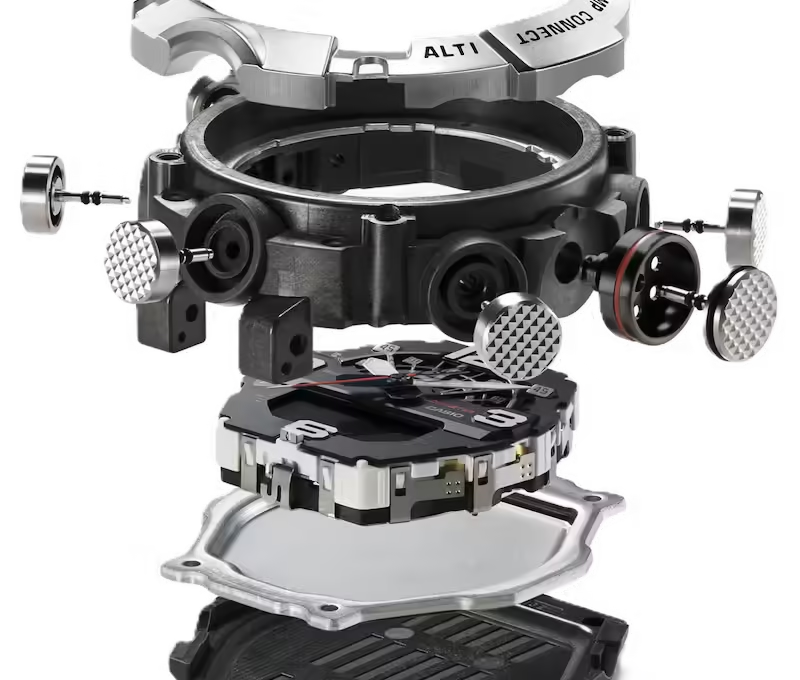
The Casio G-Shock Gravitymaster is a perfect example of this philosophy in action, with its ability to survive environments that some mechanical movements otherwise wouldn’t. Casio’s Triple G Resist technology focuses on protecting the internal module from high acceleration, constant vibration, not to mention sudden shocks.
Resilience in its most radical form: the G-Shock Gravitymaster
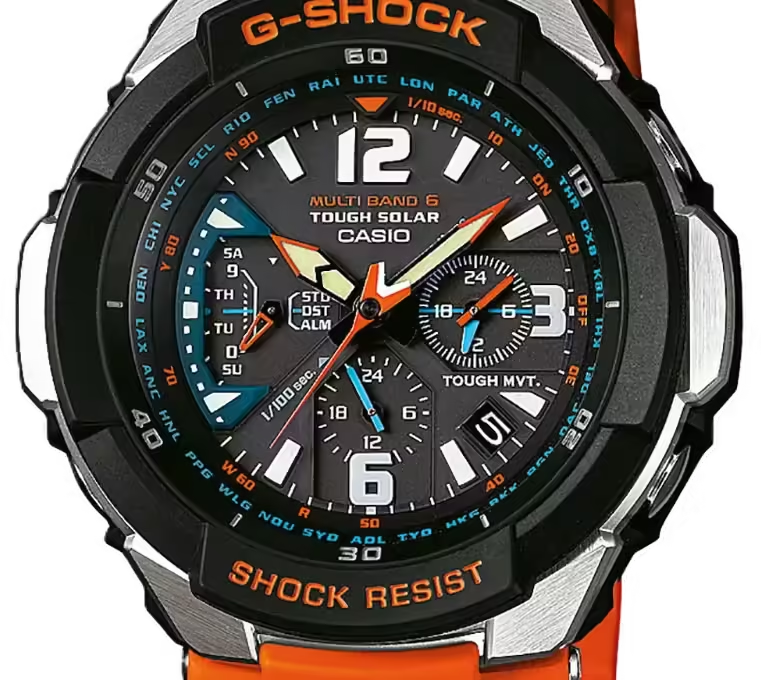
It’s easier to understand it like this; instead of rigidly mounting delicate components, Casio equips the watch with a movement that’s effectively insulated within the case. Energy is absorbed and dispersed before it can interfere with timekeeping. The electronics inside remain stable, unaffected by orientation or load. The result is a watch that doesn’t drift when the forces climb and doesn’t lose accuracy when the environment turns hostile.
Anatomy of indestructibility: the layers of Triple G Resist technology
The choice of professionals: No experiments at the limits
Mechanical watches tell extraordinary stories. They represent centuries of accumulated knowledge and a deeply emotional connection to time itself. For daily life, and even many demanding professions, they perform beautifully.
But strap one to your wrist during a nine-G banking turn, and you’re asking it to ignore the laws of physics. Modern aviators don’t turn to solid-state watches because they lack appreciation for mechanical craft. They do it because, in extreme environments, reliability is defined by indifference. The less a watch feels, the more accurately it performs. At altitude, under pressure, surrounded by vibration and force, timekeeping becomes solely about performance and tight precision. And sometimes, the most precise watch is the one that doesn’t feel a thing.
More about timepieces in extreme situations
The fascinating partnership between Bremont and Martin-Baker


