



Why Tritium is the ultimate guarantee of visibility for long night flights
Luminescent paints are brilliant – as long as the sun is shining. But for those who must rely on an external charge, a six-hour night flight means risking a ‘blind flight’ on the wrist. We explore why a constant, independent light source is far more than just a convenience for pilots: it is a critical instrument.


The world looks vastly different from 30,000 feet in the middle of the night. In the cockpit during a long-haul night flight, the environment is dark, quiet, and highly isolated. Imagine flying over the ocean, hours away from sunrise, where the ambient light of the stars is barely enough to cast a shadow. It drives home the importance of a legible, well-lit watch for such expeditions.
When scanning the instrument panel or verifying critical mission timing in dim-light conditions, reading your watch at a single glance is imperative. This is exactly where the high-stakes debate between traditional luminous paint and self-powered illumination comes to the fore. When it comes to aviation timekeeping, absolute reliability is mandatory in every sense of the word, not just from an accuracy point of view.
At 30,000 feet above the ocean, the darkness is absolute. A watch that fades halfway through the flight is no longer an instrument – it is a liability.
The Fading Promise
Modern photoluminescent paints, like the widely celebrated Super-LumiNova, are undeniably brilliant. When fully charged by ultraviolet or intense artificial light, they emit a powerful, easily readable glow which dominates the dial, whether in a bright turquoise glow or a rich green hue. But here’s the thing: they rely entirely on an external charge. While the dial is exceptionally bright immediately after light exposure, that intensity drops off significantly after the first hour of total darkness.
By hour four or five of a grueling six-hour night flight, standard lume is often a faint, faintly readable ghost of its former self. A pilot cannot afford to divert their attention or break night-vision adaptation to shine a flashlight on their wrist just to read the time. For an aviator relying on a backup timing instrument, a watch that goes dark halfway just won’t do.
The Tritium Advantage on the Dial
Unlike photoluminescent paints, tritium gas tubes provide a constant, entirely independent light source. They do not require charging from the sun, cockpit lighting, or a tactical flashlight. Instead, they glow relentlessly, day and night. This continuous illumination is achieved by injecting tritium gas (a safely contained, slightly radioactive isotope of hydrogen) into microscopic borosilicate glass tubes lined internally with phosphor. As the tritium naturally decays, it releases electrons that strike the phosphor, causing it to emit a steady, vibrant light.
Glows around the clock: The Luminox F-117 Nighthawk
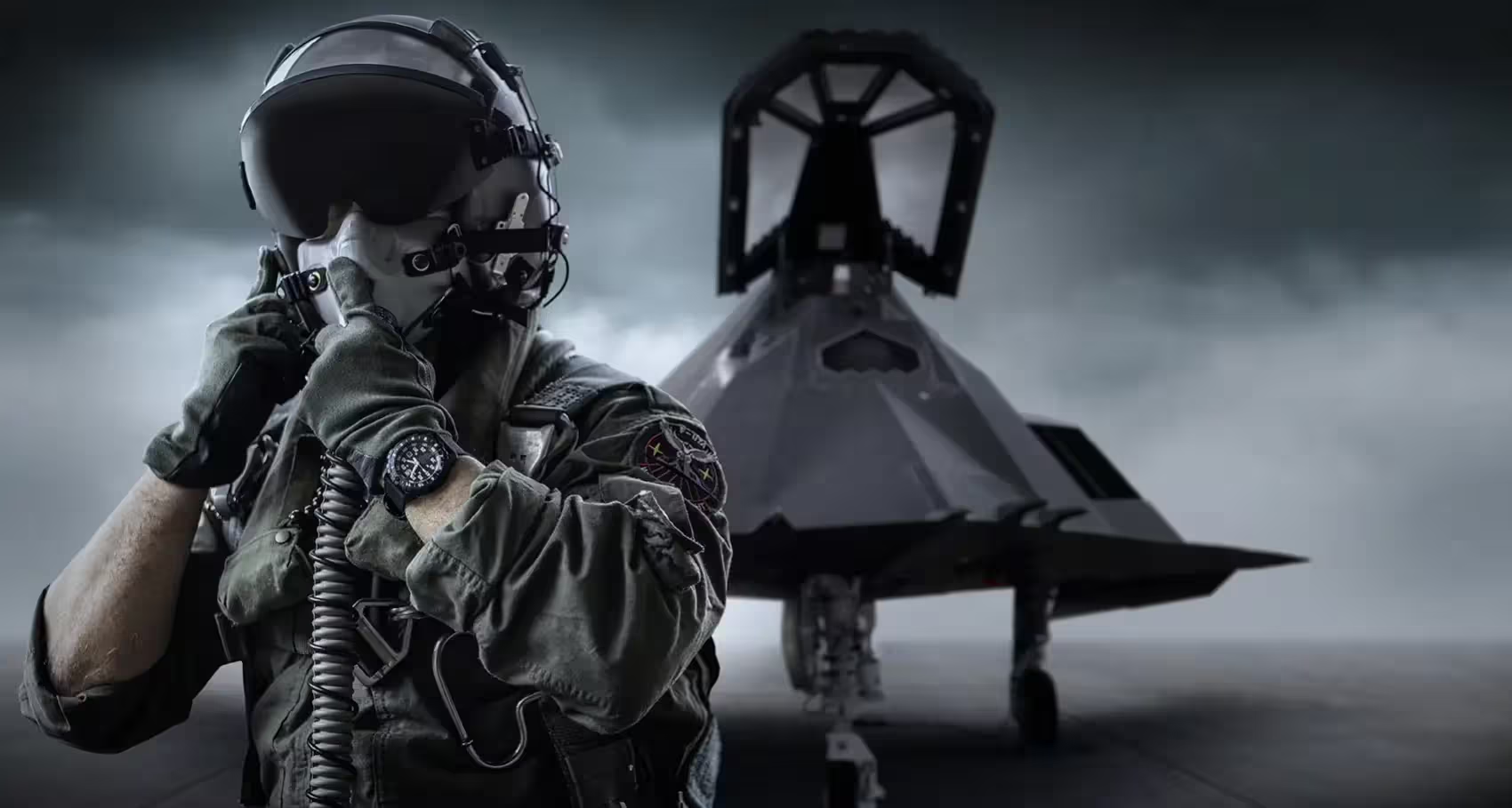
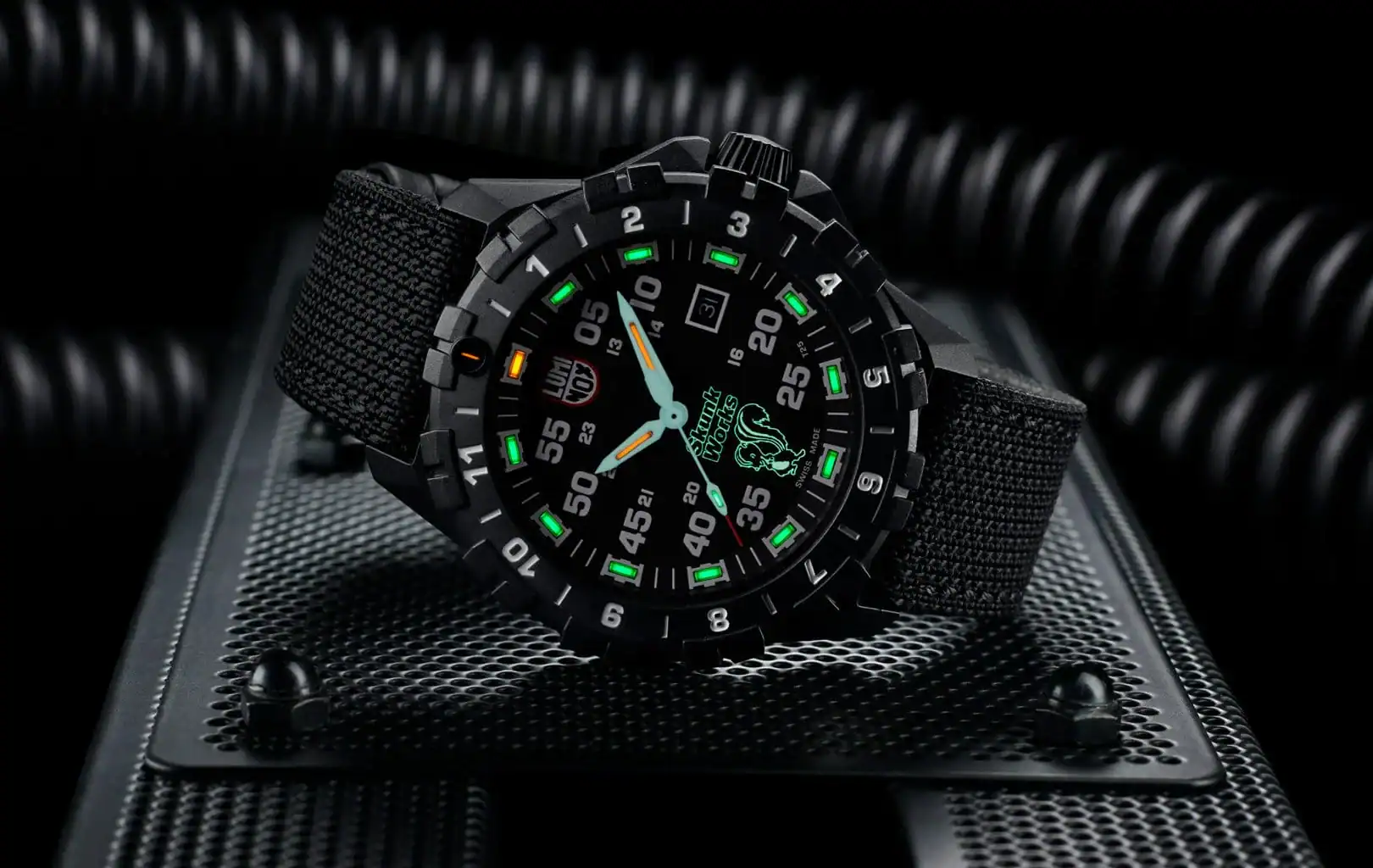
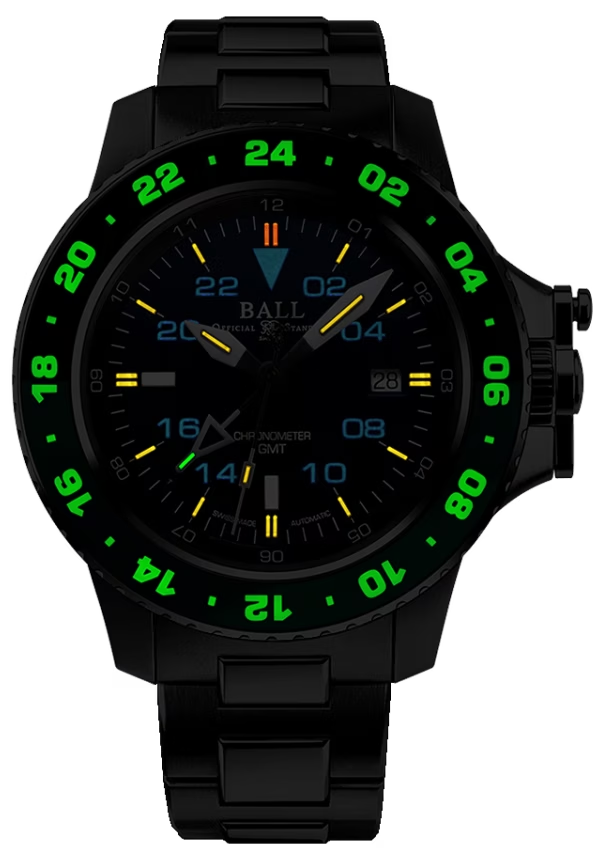
To understand the practical, tactical application of this technology, one needs to look no further than the Luminox F-117 Nighthawk. Designed in direct conjunction with American stealth pilots, this timepiece was built for an environment where outside light sources are nonexistent, and mission guidelines are strictly timed. The watch utilises Luminox Light Technology (LLT), embedding these micro gas tubes directly into the hands and hour markers. Unlike standard luminous paint that fades steadily while the hours tick by, LLT guarantees up to twenty-five years of continuous, unwavering brightness, similar to the technology used by Ball Watch Company in models such as the Engineer Hydrocarbon AeroGMT II.
Bringing light into the darkness: The Ball Engineer Hydrocarbon AeroGMT II
Conclusion
In high-risk aviation, a vital piece of gear must perform flawlessly under the exact conditions for which it was designed, without requiring extra steps from the operator. Whether it is hour one or hour twelve of pitch-black flying, the dial of a tritium-equipped watch remains perfectly readable without a second thought, assuring that a pilot’s timing companion never leaves them in the dark.
Radiation under control: Why tritium tubes are safe Although tritium is a radioactive isotope, there is absolutely no health risk to the wearer of such a pilot’s watch. The gas is securely sealed within tiny, extremely resilient borosilicate glass tubes. As a so-called ‘soft’ beta emitter, tritium possesses such low energy that the emitted electrons cannot penetrate the glass walls, the watch case, or human skin. Unlike luminous materials used in the past, no harmful gamma radiation is produced. This ensures the technology remains physically completely harmless – even with daily wear over several decades.
The ultimate pilot watch glossary
Essential terminology for the aviator’s timepiece