



Why professionals rely on redundancy when securing their pilot watches
In the uncompromising environment of an aircraft cockpit, there is an old adage that dictates the design of every piece of critical gear: “One is none, two is one.” This philosophy of redundancy ensures that if a primary system fails, a backup is immediately ready to take the load. Yet, when we look at traditional pilot watches – instruments historically relied upon for vital navigational calculations – we often find a glaring vulnerability hidden in the smallest part of their construction. The spring bar.


How a tiny metal pin becomes a hazard
Standard watches rely on spring bars to attach the strap or bracelet to the watch case. Think of a spring bar as a tiny, telescopic pogo stick; a small metal tube containing a coiled spring that provides just enough outward tension to lodge into small indentations inside the watch lugs. While spring bars are an industry standard because they allow for easy and rapid strap changes, the spring-loaded pin becomes the fragile Achilles’ heel of an otherwise robust timepiece, especially in the cockpit.
In the confined space of a cockpit, a watch can quickly get caught or damaged – but the greatest danger is losing it altogether.
Within the high-stress confines of a modern cockpit, a pilot’s wrist is in perpetual motion, navigating a labyrinth of complex instrumentation, control yokes, and heavy-duty safety harnesses. This dynamic environment presents a multitude of hazards: a watch can easily snag on flight gear, while a violent strike against a rigid instrument panel can unwittingly compress the fragile internal spring of a standard bar. The ultimate peril, however, is total detachment.
Because traditional two-piece straps are anchored independently to each lug, the failure of a single spring bar results in catastrophic separation, sending the timepiece plummeting. In the unforgiving realm of aviation, losing your primary navigational timer beneath a seat during severe turbulence is a distraction and a profound safety hazard.
The NATO strap as a tailhook on your wrist
The first line of defence against the rogue spring bar is the NATO strap. Instead of two separate separate pieces of material, a standard NATO strap is a single, continuous loop of rugged nylon webbing. It passes completely behind the watch head, weaving over and under both spring bars before securing to the wrist. This design applies the “two is one” principle perfectly: if a heavy snag causes a single spring bar to fail, the watch does not plummet to the floor. Instead, it remains anchored to the wrist by the surviving spring bar and the strap’s continuous loop. The watch may dangle, but thanks to its “tailhook,” it is not lost.
Maximum security thanks to fixed bars
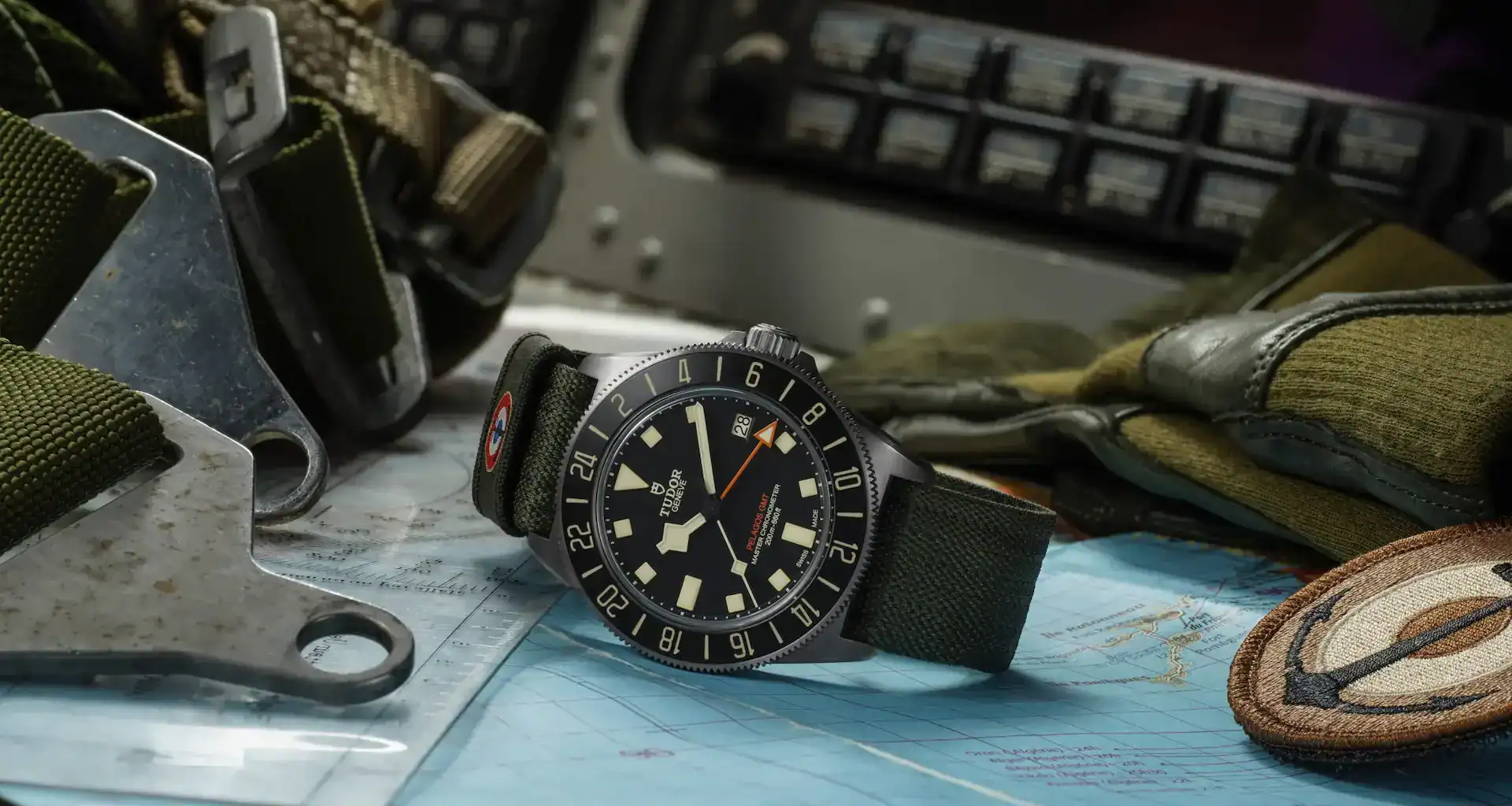
While the NATO strap is a brilliant arresting hook, elite aviation gear prefers to eliminate the risk of falling altogether with the fixed-lug construction; case in point – the Tudor Pelagos FXD. To understand the pinnacle of this fail-safe engineering, consider this watch as an example. The “FXD” stands for extra-robust “Fixed” strap bars. Unlike traditional watches, the Pelagos FXD does not use removable pins. Instead, the strap bars are machined directly into the case from a single, solid block of titanium.
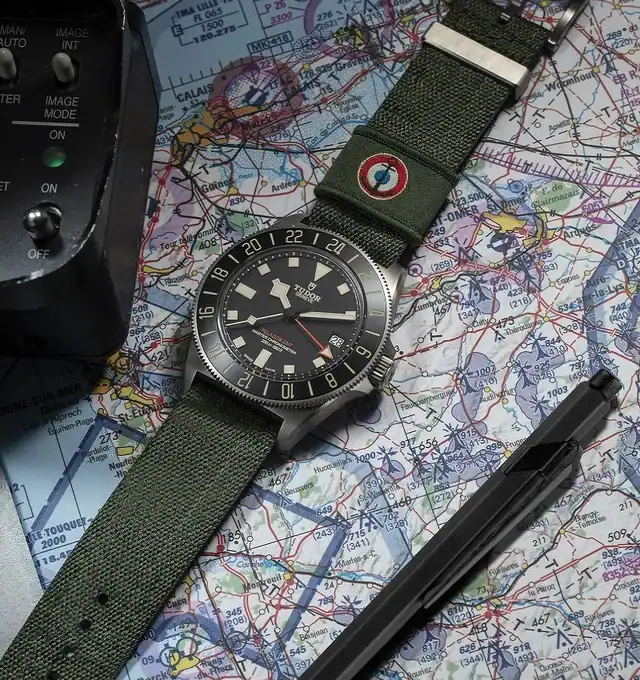
There are no internal springs, no telescopic tubes, and no microscopic points of compression. The lug is an immovable, indestructible metal bridge. Because there is no spring bar to fail, the single point of failure is completely eradicated. When you thread a high-strength woven pass-through strap through these solid titanium bars, the watch becomes practically fused to the pilot’s wrist.
Double security: the Tudor Pelagos FXD with fixed lugs and NATO strap
The verdict
A pilot’s gear is only as reliable as its weakest link. By replacing the fragile, compressible spring bar with a solid, machined piece of the case and pairing it with a single-pass strap that guarantees continuous attachment, modern aviation timepieces turn what can sometimes be a temperamental accessory into a rugged, fail-proof instrument. In the cockpit, where there is no room for error, the fixed lug and NATO strap combination proves that sometimes, the ultimate sophistication is simple, unyielding strength.
The Great Watch Encyclopedia
The most important technical terms relating to pilot watches